
 Blog Details
27-03-2026
In agricultural and food-processing industries—especially across India and other grain-producing regions—product quality directly determines market value, safety, and brand reputation. One critical quality challenge processors face is the presence of Dunki products. Understanding what Dunki sorting is and why Dunki products must be sorted is essential for millers, exporters, and food manufacturers aiming for premium-grade output.
Dunki refers to defective, immature, damaged, or discolored grains or food products that deviate from normal quality standards. These defects may occur due to:
Dunki products are commonly found in commodities such as rice, wheat, pulses, lentils, peanuts, maize, spices, and seeds. While they may look similar to healthy grains at first glance, their internal and external quality is compromised.
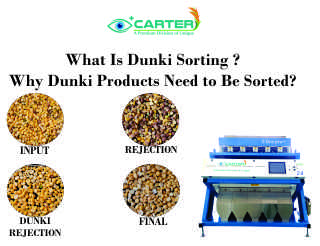
Dunki sorting is the process of identifying and removing defective or substandard products from the main batch to ensure uniformity, safety, and compliance with quality standards.
Traditionally, Dunki sorting was done manually, which was:
Today, modern optical color sorter machines use advanced cameras, sensors, and AI-based algorithms to automatically detect and reject Dunki products based on:
This automated approach ensures high-speed, high-accuracy sorting, even at industrial-scale volumes.
Sorting Dunki products is not optional—it is a critical quality-control step. Here’s why:
1. Quality Consistency and Market Value
Dunki products reduce the overall grade of a batch. Even a small percentage of defective grains can:
Sorting ensures uniform color, size, and appearance, which buyers demand.
2. Food Safety and Consumer Health
Some Dunki products may contain:
If not removed, these defects can pose serious health risks and lead to:
3. Export and Compliance Requirements
Global food markets have strict quality standards. Export authorities and international buyers reject shipments containing:
Dunki sorting ensures compliance with international food safety and export regulations, reducing rejection rates.
4. Improved Processing Efficiency
Defective products behave differently during:
Unsorted Dunki materials can:
Sorting improves downstream processing performance and reduces operational losses.
5. Stronger Brand Reputation
Consistent quality builds trust. When customers receive clean, uniform, defect-free products, it:
Dunki sorting protects not just the product—but the brand itself.
Advanced optical sorting systems are designed to:
These systems ensure maximum yield, minimal waste, and consistent quality, making them indispensable in modern food-processing plants.
In each of these sectors, Dunki sorting directly impacts profitability and compliance.
Dunki sorting is a vital quality-control process that ensures defective, damaged, or unsafe products are removed before reaching the market. Dunki products—if left unsorted—can lower product value, compromise food safety, disrupt processing efficiency, and damage brand reputation.
By adopting advanced optical color sorting technology, processors can achieve:
In today’s competitive and quality-driven market, effective Dunki sorting is no longer an option—it is a necessity.
Copyright © 2024 Carter Unique Group. All Right Reserved.